

Since its founding in 1989, SPARX Group Co., Ltd. and its affiliated companies ("SPARX Group") have managed investments using a thorough bottom-up approach grounded in the philosophy that "Macro is the Aggregate of Micro." Thus, SPARX Group has offered asset management services that have earned the trust of numerous clients.
By achieving sustainable growth and improved corporate value over the medium to long term, SPARX Group keeps striving to realize its mission "to make the world wealthier, healthier, and happier" as it becomes "the most trusted and respected investment company in the world."
To further improve corporate governance, SPARX Group's Audit and Supervisory Committee―whose members are appointed as part of the Board of Directors―audits the directors' executive actions to delineate the boundary between audits and executive action and improve the supervisory function of the Board. The establishment of this Committee also accelerates executive action by largely transferring authority from the Board to the directors themselves.
Corporate Governance(The below is based on data as of March 31, 2026)
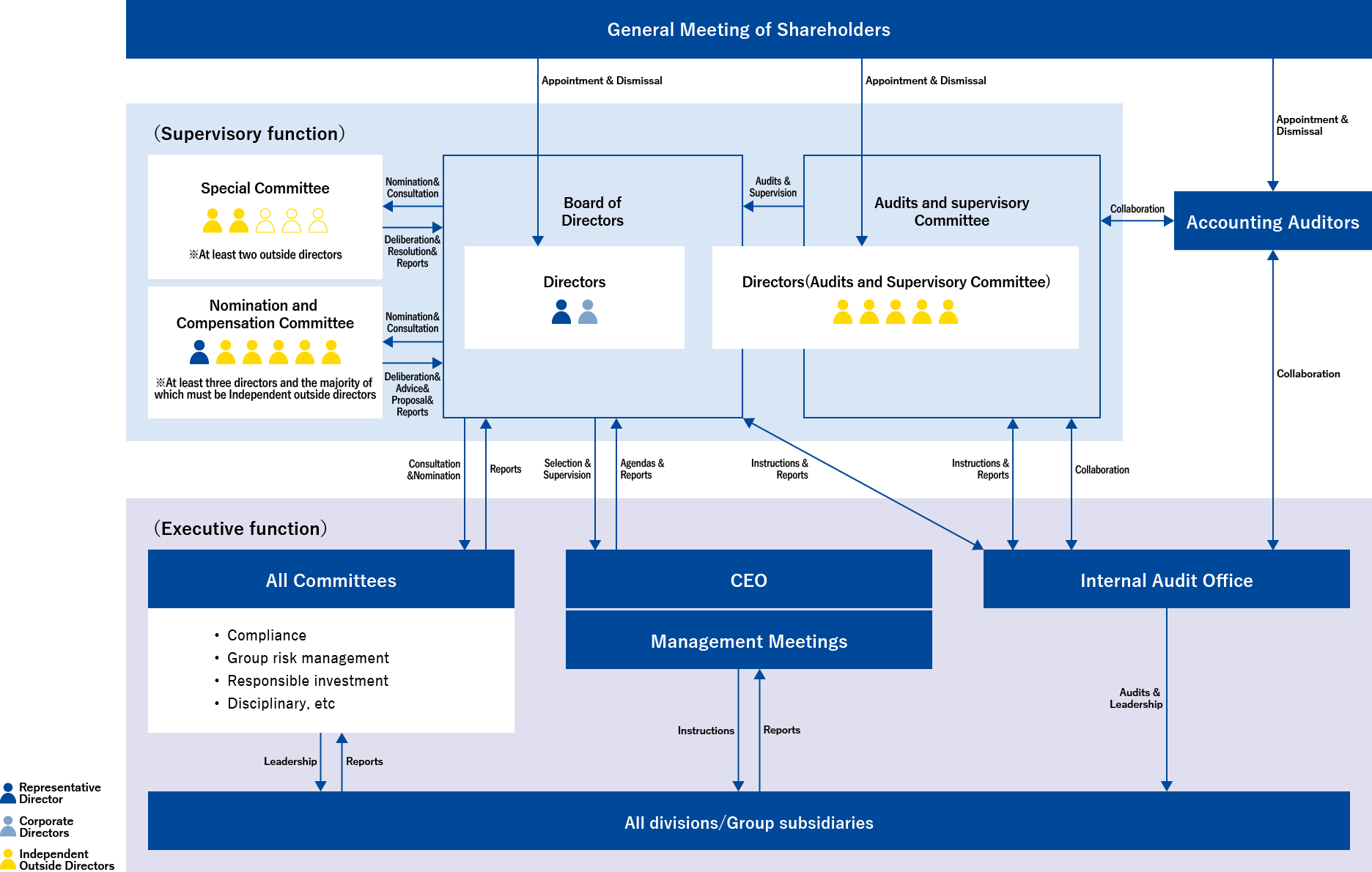
Board of Directors & Directors
The Company's Board of Directors consists of seven highly experienced directors. It regularly meets once a month and holds emergency sessions as necessary to formulate basic policies on management and important management decisions.
SPARX Group sets its directors' (excluding Directors who are Audit and Supervisory Committee members) terms to one year to more clearly delineate their administrative responsibilities, to improve the Company's operational structure, and to dynamically form an operational framework in response to changes in the business environment. The Audit and Supervisory Committee directors' terms are for two years. Moreover, the Company invites five outside directors to join the Board to improve its governance framework. These outside directors offer the Board of Directors independent, objective expertise and further expand its decision-making and supervisory functions.
Audit and Supervisory Committee
The Company's Audit and Supervisory Committee consist of the five outside directors (all of them are independent outside directors). It monitors the compliance and appropriateness of the Company's operations. The term of office for directors serving on the Audit and Supervisory Committee is two years. In addition, to further reinforce the Committee's supervisory function―given that it is composed solely of outside directors―the Internal Audit Department, which examines overall management activities and conducts operational audits, works in close coordination with the Committee.
Management Meeting
The Company has established a Management Meeting―comprising of representative directors, managing executive directors, and Group executive officers―to deliberate on important business execution decisions delegated by the Board of Directors to the CEO.
Nomination and Compensation Committee
The Company has established a Nomination and Compensation Committee to bolster the independence, objectivity, and accountability of the Board's functions regarding the nomination and compensation of directors and Group executive officers, while also helping ensure the transparency of SPARX Group's management.
Special Committee
The Company has established a Special Committee composed of at least two outside directors. The Committee deliberates on significant transactions and actions in which the interests of the Company's majority shareholders may conflict with those of minority shareholders, resolves whether to approve such matters, and conducts verification and oversight to ensure their appropriateness.
Internal Audit Department
The Company has established an Internal Audit Department with the objective of examining overall management activities and auditing whether business operations are being conducted appropriately and efficiently in accordance with laws, regulations, and corporate ethics. Through the enhancement and maintenance of internal control systems, the Internal Audit Department contributes to strengthening the Company's management foundation and supports the effective achievement of management objectives.
Other
The Company also has the Group Risk Management Committee to manage group-wide risk management through analysis and evaluation based on the results of risk surveys; the Compliance Committee to ensure thorough compliance with the Financial Instruments and Exchange Act and all related laws, ordinances, and regulations; the Responsible Investment Committee to consider and discuss issues pertaining to responsible investment principles, including our responses to climate change risks and opportunities; and other committees that investigate, deliberate, formulate, and report on all inquiries concerning directives from the Board of Directors. Furthermore, compliance managers, including those at subsidiaries abroad, remain in close contact with each other and review, from a global perspective, legal compliance and risk management concerning Company operations.
Skills Matrix for Directors
The Company's Board of Directors remains cognizant of the diversity and international acumen necessary for growing the business of SPARX Group and therefore selects director candidates based on whether they are equipped with extensive knowledge and experience in corporate management and with the qualifications, abilities, and expert knowledge that will contribute to improved corporate value. Candidates should also be able to actively participate in the Board's diverse, constructive discussions, and they should be "individuals with an excellent sense of humanity who have the track record and experiences needed to fulfill all their duties as directors of the Company, and who are qualified to further grow and expand the businesses of the Group in the future." To facilitate supervision and the provision of advice on the formulation of basic management policies, as well as decision making for particularly material management decisions, and the execution of tasks by directors and Group executive officers, appointments are made to ensure that the Board has a good overall balance of knowledge, experience, and abilities, while also accounting for the balance―in light of the scale, etc. of the Group's business― between Board size and diversity. Reflecting on operational strategies, the Company's Board of Directors has identified seven essential abilities - management in general, investment evaluation/analysis duties, business development/marketing duties, international business, experience in other industries, finance/accounting, and compliance legal/risk management - as the knowledge and experience required of each member.
Please refer to the link below for more details on the skills matrix included in the Notice of the Ordinary General Meeting of Shareholders.
https://ssl4.eir-parts.net/doc/8739/announcement1/109382/00.pdf
Director Compensation
The Company regards its director compensation system as an essential part of corporate governance. The Company has established this system to determine compensation so that those who resonate with the Group's mission and vision, share the values of empirical research and the importance of communication, and have above average knowledge, insight, and human qualities will be motivated―both monetarily and non-monetarily―to achieve sustainable growth and increase corporate value over the medium to long term.
Specifically, this compensation system consists of three components: (i) a base salary, (ii) short-term performance bonuses, and (iii) medium- to long-term performance bonuses. Economic and market conditions greatly influence performance in the Group's primary business of investment trust management, discretionary investment management and investment advisory, so the Company ensures that (ii) short-term and (iii) medium- to long-term performance-based compensation are weighted more heavily than (i) base salary to align with its stakeholders' interests. Specifically, the compensation system is designed to have a target ratio of 3:7 for base salary to performance bonuses. The Company also takes care to ensure that the total compensation is attractive compared with other investment firms and competitive enough to draw talented people, taking reference from data on executive remuneration at companies listed on the Tokyo Stock Exchange's Prime Market, data on executive remuneration at asset management companies located in Japan, and other data provided by remuneration consultants and other third parties.
At the 31st ordinary general meeting of shareholders held on June 9, 2020, the Company voted to set the maximum amount of compensation for directors (excluding directors who are also Audit and Supervisory Committee Members and outside directors; limited to within 5 persons pursuant to Article 18, Paragraph 1 of the Articles of Incorporation) at JPY 1.5 billion per year (excluding employee wages). Separately from this maximum compensation amount, at the 33rd ordinary general meeting of shareholders held on June 10, 2022, the Company passed a resolution to set the maximum amount of compensation under the performance-based stock compensation plan at JPY1.8 billion for four fiscal years from the fiscal year ended March 31, 2023 to the fiscal year ending March 31, 2026.
If certain events are identified, such as material fraud or violation by the persons eligible for executive compensation or material accounting errors, a clawback clause may be stipulated whereby all or part of the compensation has paid for directors may be reimbursed. This shall be done by a resolution of the Board of Directors after it has sought the advice of the Nomination and Compensation committee. Directors subject to such reimbursement include those who have already retired from the company. In addition, the directors' compensation to be reimbursed shall be all or part of the compensation for the fiscal year in which the material fraud, violation, and material accounting errors occurred, including amounts that have already been paid.
(i) Base salary
Because SPARX Group is a holding company, its directors' primary duty is to focus on maintaining and improving Group governance. As a result, as a general rule, only the base salary portion of the compensation paid by the Company should be determined by position and whether directors are full-time or not.
When SPARX Group directors (excluding Directors who are Audit and Supervisory Committee members) who concurrently hold director positions at its Group companies and assume responsibility for their operations, the Company determines the total compensation for each director in light of their overall duties to the Group. SPARX Group, as the holding company, pays the base salary mentioned above, then the Group subsidiaries subtract this base salary from the set total compensation and pay the remainder as the base salary for each director's concurrent role at a Group subsidiary. The base salary is paid in monetary form each month in 12 equal portions.
(ⅱ) Short-term performance-based compensation (performance bonuses)
The Company analyzes the Group's business performance figures and comprehensively considers returns to shareholders, retained earnings, and the outlook for the next fiscal year and beyond with regard to the operating environment, operating plans, capital plans, and expected performance. After comparing these figures to the previous fiscal year's bonus payments, the Company determines what percentage of the Group's total profit for a fiscal year will be allocated as reserves for paying bonuses to all Group directors, managers, and employees.
In the process, the Company also determines what percentage of these reserves will be allocated for bonuses to directors (excluding Directors who are Audit and Supervisory Committee members).
Next, the Company conducts qualitative and quantitative evaluations for each director (excluding Directors who are Audit and Supervisory Committee members), judging factors that include comparisons with important Group operating indicator targets and actual results (see below), directors' contributions to the Group's business execution, and their achievement of personal goals. Evaluation factors are weighted differently according to each director's position and responsibilities.
- Efficiency: ROE
- Stability: core earning power
- Profitability: operating profit
- Most fundamental operating indicator: AUM net inflow
Finally, using these evaluations' results, the Company will determine the total performance bonus for each director (excluding Directors who are Audit and Supervisory Committee members) and pay these bonuses through the Group subsidiaries at which each director also serves. These bonuses are paid in a monetary form at the beginning of the subsequent fiscal year.
(iii) (Medium- to long-term) performance-based stock compensation
To further encourage a commitment to the medium- to long-term growth of SPARX Group and clarify the link between directors' compensation, the performance of the business, and the company's share value, we have introduced a stock compensation system for our directors to be rewarded according to the degree of their achievement of the medium- to long-term targets and their personal goals. The Nomination and Compensation Committee, which is a voluntary advisory committee to the Board of Directors, discusses the medium- to long-term targets for remuneration and reviews the stock grant matrix, which differs according to a person's position. The Board of Directors will respectfully review and consider the advice proposed by the committee before deciding the final grant allocations.
The Company believes that stock compensation is consistent and in line with medium- to long-term interests of shareholders and other stakeholders. A point system has been created to determine the number of shares to be granted to each director. Points are calculated at the end of the consolidated fiscal year in accordance with the stock grant matrix. Shares are required to be held for a three-year period once issued. Furthermore, during the holding period, if a director has violated any compliance or other matters stipulated in the Group's various regulations, or if the director is dismissed from the Board of Directors, the Company will not grant shares.
Because the current CEO has already acquired more than a sufficient number of shares, he shall not be eligible for this form of compensation.